


SWINGERS

Table of Contents

What is Swinging? 

Swinging is when one established couple engages in sexual activity with another already established couple. Swinging requires consent from all parties, and while couples engage in sexual non-monogamy, they are expected to remain emotionally and romantically monogamous to their partner. Swinging is often seen as a way to “spice up” a marriage or committed relationship without the traditional idea of cheating on a partner.


The act of swinging has been practiced for a long time, but gained popularity in the 60s and 70s during the hippie movement. Studies show that around 4% of American adults have experiences in some sort of open relationship; however, statistics about only swinging are difficult to find. While swinging is present and popular in many countries, this page focuses on swinging in the United States.  

Two sets of hands holding one another

How is swinging different than polyamory? 

Swinging frequently gets misidentified as polyamory, which reduces the experience of swingers. It is important to distinguish the two: polyamory refers to an individual participating in sexual or romantic acts with more than one person, while swinging indicates the involvement by already established romantic pairs with at least one other person or pair (Berstrand and Belvins Williams 2000).
Established couples can swing with other couples or singles
An assortment of people in relationships or not can be polyamorous

How it Works

Many times, swinging occurs through institutional organizations such as swingers’ clubs, conventions, cruises, vacations, or other events (Walshok 1971). These events and the larger subculture of swinging have their own social scripts and vocabulary, rules, and sacred symbols/objects. 

At a swingers convention, ethnographer Claire Kimberly observed that the husband in heterosexual couples usually completed the first “screening” of couples and that the wife would usually have the final say (2015). Once the couples are acquainted, conversations often take place about each couple’s boundaries or rules in swinging, and then one couple usually invites the other couple to “play” (Kimberly 2015).

In party swinging (three or more couples involved), the host is usually in charge of transitioning the event from social behavior to sexual behaviors in ways that are recognized by members of the subcultural swinging group like dimming the lights (Varni 1972).


One inteUpside Down Pineapple Pin sold by Oral Betsey | SKU 3202345 | Printerval UKresting part of swinging culture is the role of the upside-down pineapple: it symbolizes to other couples in hotels, events, and especially cruises, that they are looking for a couple to swing with (via digitalcultures.net). This is an example of a symbol that has significant meaning only to this group. 
Video (below): “Visiting a Swingers Resort to Become a Better Man”

In this short documentary, a man goes to a swingers resort and learns about the lifestyle to improve his communication skills. We hear from a regularly swinging couple, see how to and how not to approach couples, important terms of swingers, and learn about consent. This video can be useful in becoming more familiar with swinging practices, and learn some of the social scripts involved in swinging.


***This video contains blurred nudity, sex, and BDSM content***

Swinging as Deviant: Resistance and Reinforcement

Swingers are often seen as deviant by the larger society. This is due to the labeling from outsiders as divergence from normative sexual practices. The labeling theory of deviance describes how nothing is inherently deviant, but that deviance is determined by the label of society (Haenfler 2023). Still, the social implications of being deviant are still very real. 


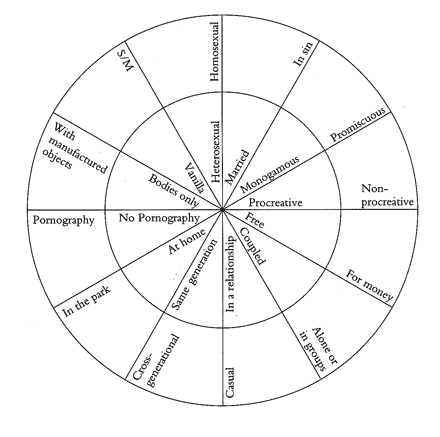
Gayle Rubin, an American anthropologist, organized some of these sexually deviant and non-devant labels through a visual (see below) called “the charmed circle ” (Rubin 1998).

The inside of this circle describes sexual behaviors that are “safe” and generally accepted by the majority of society. The outside of the circle describes behaviors that are, at the least, frowned upon, and at the most, criminalized or dangerous to engage in. 


Swingers engage in activities both on the inside and outside of the circle. Their deviant behavior includes: promiscuous, non-procreative, and in groups. Their normative behaviors generally include: in a relationship, married, and at home. Swinging can be in the center or outside of most of the other categories.


Rubin’s Charmed Circle shows how swingers can both resist heteronormative ideas of sex and reinforce them at the same time. They resist the belief that intimacy should be confined to private spaces with just one partner. However, they simultaneously meet the expectations of emotional and romantic intimacy by being committed long-term in these ways to just one partner. By conforming to the more public expectations and breaking the private ones, swingers can keep one foot in the door of the privilege that comes with being monogamous while still exploring non-normative sexual situations.

"I love the fact that my relationship has that much freedom to it, and knowing that we'll never be sexually bored. I love the fact that I don't have to worry about being tempted to cheat, or that I don't have to wonder what would happen if I slept with someone else."

This quote from Sasha Konikovo shows the boundary between normative couple expectations and resistance of normative sexual practices. Read her account of swinging here.

The views and opinions expressed on individual web pages are strictly those of their authors and are not official statements of Grinnell College. Copyright Statement.