
In the late 1960s and early 1970s, Britain’s post-war economic boom began coming to an end. This period of economic decline continued into the early 1980s, marked by a rise in unemployment, inflation, and labor strikes. During this time, options for working-class youths were limited, especially in the blue-collar industrial town of Birmingham.

From Birmingham came Black Sabbath, revered by many as the first metal band ever. Their music gave voice to their experiences, “dead end prospects and boring school seemed to inspire a music that was steeped in rage” (Cope 2010, 97). Heavy metal reflected the mood of the disenfranchised youths on the margins of society. Like the emergent punk scene, heavy metal reflected an anti-establishment tone, but separate from punk would evolve into a genre embracing escapism and fantasy in a way that punk did not. Its mood and sound are heavily rooted in the Hard Rock of the 1960s, draw inspiration from groups such as Led Zeppelin and Cream (Heart 2021). Factory life not only influenced the themes of heavy metal music but also the general tone as well-Black Sabbath guitarist Toni Iommi lost the tips of his fingers in a factory accident, and would loosen his strings allowing him to play easier. This led to a darker, muddy sound.
| SUB-GENRE | ARTISTS |
| Thrash Metal | Metallica, Slayer, Megadeth, Anthrax, Exodus, Sodom, Overkill |
| Glam Metal | Poison, Motley Crue, Twisted Sister, Skidrow, Ratt, Bon Jovi |
| Power Metal | Iron Maiden, Stratovarius, DragonForce, Sonata Arctica, Blind Guardian |
| Death Metal | Cannibal Corpse, Death, Morbid Angel, Behemoth, Deicide, Nile |
| Black Metal | Gorgoroth, Mayhem, Burzum, Emperor, Bathory, Darkthrone, Immortal |
| Grindcore | Carcass, Napalm Death, Pig Destroyer, Wormrot, Anal Cunt, Brutal Truth |
| Industrial Metal | Nine Inch Nails, Marilyn Manson, Ministry, Killing Joke, Rammstein |
| Alt Metal | Korn, Slipknot, Limp Bizkit, Evanescence, Poppy, System of a Down, Linkin Park, Babymetal |


Heavy Metal is the subject of a moral panic centered around the idea that heavy metal music somehow increases the chance of suicide, especially in young adults. The perceived connection between heavy metal and suicide is used by some to explain the increase in suicide rates in recent decades. Moral entrepreneurs point to the genre’s references to societal and mental chaos as well as lyrical themes of suicide, homicide, and Satanism to back their argument (Scheel & Westfield 1999). A vast array of literature exists on this subject, but in an empirical analysis Scheel & Westfield (1999) argue there exists no causal link between listening to heavy metal music. Heavy metal fans have higher than average rates of drug and alcohol abuse, delinquency, recklessness, and a lower socio-economic status (Scheel & Westfield 1999). These characteristics overlap risk factors for suicide, and make it hard to argue that heavy metal music causes suicide. Like in many cases, moral entrepreneurs use mass media to advance an agenda against a group of people they do not understand.
Mainstream society dissatisfies most participants of subcultures, and they adopt a subcultural identity in order to have space to express themselves (Haenfler 2013). Many youths who feel oppressed or ostracized from their peers might turn towards metal because of dark and bleak themes that appeal to disenchanted youth (Haenfler 2013). Metal fans often take pride in the state of isolation and alienation. They reject the goals and values presented by society (Arnett 1996).
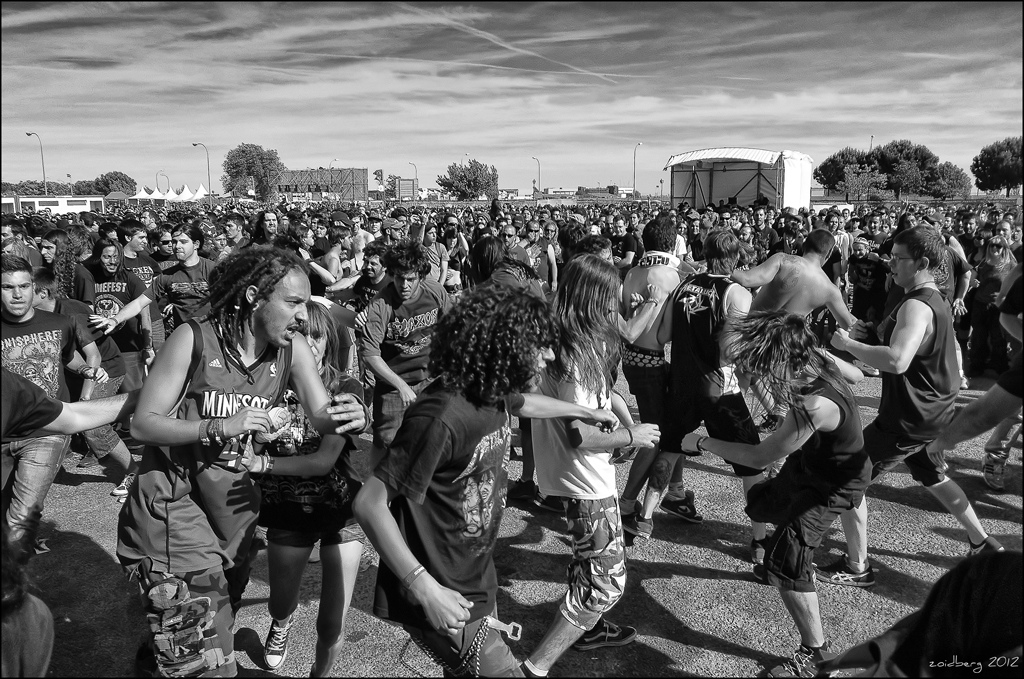
Aside from Glam Metal, hypermasculinity dominates the metal scene. These themes include sexual power, domination of women, and risky behavior (Krenske & McKay 2000). Many of these themes could come from the socialization of young people to be independent. For some, “independence becomes loneliness, self-sufficiency may shade into isolation, individualism may take an alienated form” (Arnett 1996, 16). Arnett’s (1996) work points to the existence of some connection between alienation and masculinity. Alienation creates variance in socialization, and heavy metal draws individuals because of its hyper-masculine themes.
Page by Sam Galanek
Significant Scholarship
 Arnett discusses the culture of alienation that is created within adolescents in the metal scene. He also addresses the issue of suicide in youths that listen to this music.
 A POMH journal article addressing the notion of controversy within Metal. Attempting to answer the question: When is something Metal? When is it ‘too’ Metal? How does the creation of controversy add to the metal genre?

Walser considers the perception of heavy metal, and this source addresses many of the common critiques of heavy metal, such as how it could lead to violence and suicide in youths.
Weinstein, Deena. 2009. Heavy Metal: The Music and its Culture. Boston: Da Capo Press.

Weinstein is a leader in the sociology of metal. Her book provides insight to the inner-workings of the subculture and its participants. A good book to start with for anyone interested in learning more about Metal music and its participants.
An entry from the British Medical Journal discussion the physical dangers of participating in ‘headbanging’. Details the associated risks with performing authenticity.
This article examines the globalization of Metal, highlighting the multi-faceted landscape of Metal music in Germany.
An empirical study on the effects of Metal and Rock music and videos on the suicidal tendencies of youths.